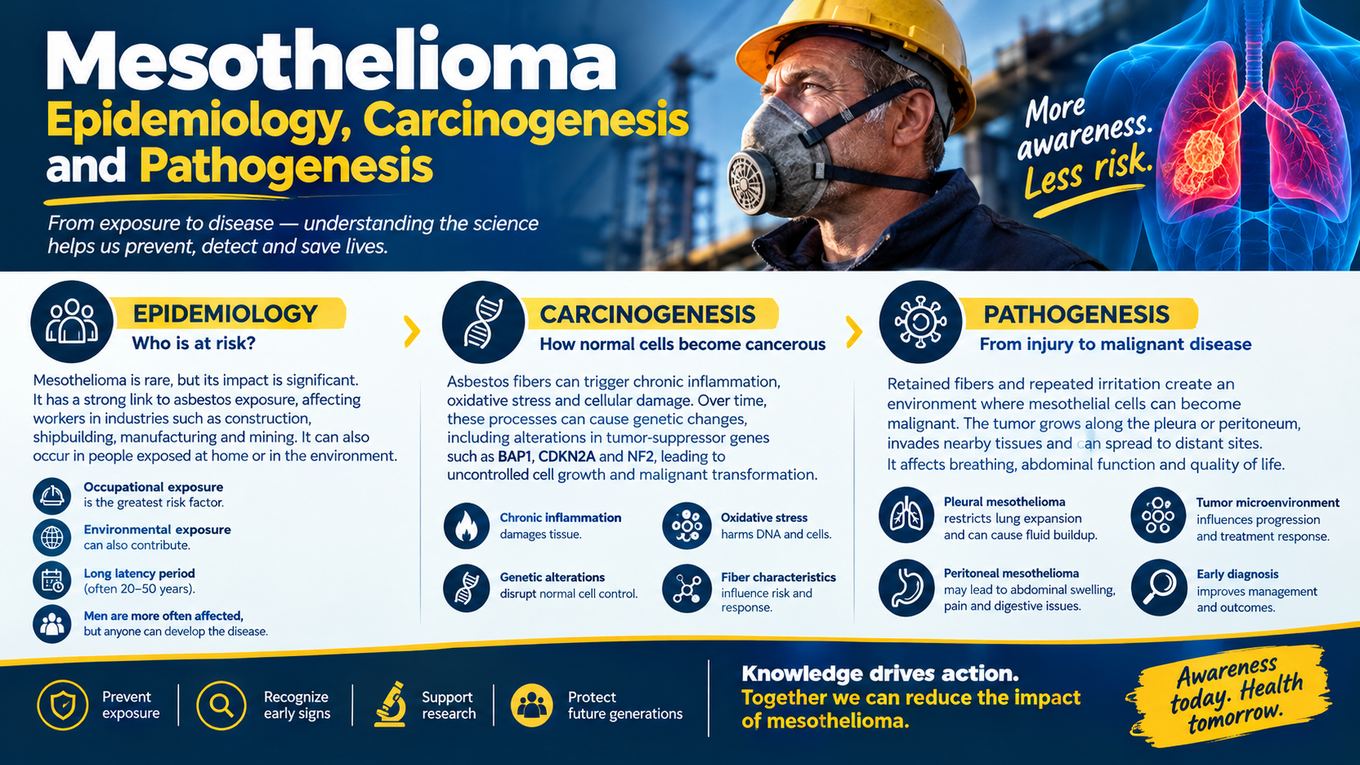
Mesothelioma Epidemiology, Carcinogenesis and Pathogenesis: Understanding the Science Behind a Preventable Cancer
Mesothelioma is a rare and aggressive malignancy that continues to present significant challenges to public health, medical research, and cancer care worldwide. Although its diagnosis can be devastating, understanding its epidemiology, carcinogenesis, and pathogenesis offers an essential opportunity to improve prevention, strengthen early recognition, and advance treatment strategies. Behind every statistic is a human story involving occupational exposure, environmental risks, delayed symptoms, and the urgent need for greater awareness. By exploring how mesothelioma develops, who is most vulnerable, and why the disease remains difficult to manage, we can better understand the importance of prevention, scientific innovation, and timely medical evaluation.
Epidemiology: Understanding Who Is at Risk
Mesothelioma originates in mesothelial cells, which form the protective membranes surrounding several internal organs. The most common form is pleural mesothelioma, affecting the lining around the lungs. Other forms include peritoneal mesothelioma, which develops in the abdominal lining, and, much less frequently, tumors involving the pericardium or tunica vaginalis.
The global distribution of mesothelioma reflects historical patterns of asbestos use, industrial development, occupational practices, and the effectiveness of workplace regulations. Although many countries have restricted or prohibited asbestos, the disease remains a significant concern because its development may occur decades after exposure. Consequently, communities can continue experiencing new diagnoses long after asbestos-containing materials have been removed from active industrial use.
Asbestos exposure is the principal established risk factor for malignant mesothelioma. Historically, asbestos fibers were widely used in construction, shipbuilding, insulation, manufacturing, mining, and other industrial activities because of their durability and resistance to heat. Workers who handled these materials, maintained industrial equipment, or worked in buildings containing deteriorating asbestos products could inhale or ingest microscopic fibers. Family members of exposed workers could also encounter fibers carried home on contaminated clothing.
Importantly, occupational exposure is not the only concern. Environmental exposure may affect people living near asbestos mines, processing facilities, or contaminated sites. Certain individuals may also encounter asbestos during renovations or demolition of older buildings when appropriate safety precautions are absent.
Mesothelioma generally has a long latency period, often several decades between initial exposure and diagnosis. This delay complicates epidemiological investigations and makes historical employment records particularly valuable. Researchers must consider past occupational histories, environmental conditions, age, geographic location, and changing industrial practices when evaluating disease patterns.
Although mesothelioma predominantly affects older adults, its occurrence in younger individuals is possible. Men have historically represented a larger proportion of diagnosed cases in many countries, partly because of occupational exposure patterns. However, women and people without recognized occupational exposure can also develop the disease. These differences emphasize the importance of assessing individual exposure histories rather than relying on demographic characteristics alone.
Carcinogenesis: How Normal Cells Become Cancerous
Carcinogenesis describes the biological process through which normal cells acquire changes that allow uncontrolled growth and malignant transformation. In mesothelioma, asbestos fibers can contribute to this process through several interconnected mechanisms, including chronic inflammation, oxidative stress, cellular injury, and genetic alterations.
When asbestos fibers enter the respiratory system, some may become trapped in lung tissue or reach the pleural space. The body’s immune system attempts to remove these foreign materials, but certain fibers are difficult to eliminate. Persistent exposure and retained fibers can stimulate prolonged inflammatory responses that damage surrounding tissues.
Inflammatory cells may release reactive oxygen and nitrogen species, chemically active molecules capable of damaging DNA, proteins, and cellular membranes. Repeated injury and repair can create conditions in which abnormal cells survive and accumulate additional changes. Over time, these changes may interfere with normal mechanisms that regulate cell division, repair DNA damage, and eliminate severely damaged cells.
Asbestos-related carcinogenesis is not explained by a single molecular pathway. Fiber characteristics, including length, durability, and biopersistence, can influence biological responses. The mineral composition and dimensions of fibers also affect how they interact with tissues and immune cells.
Genetic susceptibility contributes to individual differences in risk. Alterations involving tumor-suppressor genes, including BAP1, CDKN2A, and NF2, have been implicated in mesothelioma development. These genes participate in important cellular functions such as controlling proliferation, maintaining genomic stability, and regulating signaling pathways. When their normal functions are disrupted, cells may gain a greater capacity to survive and multiply abnormally.
Inherited pathogenic variants in BAP1 can predispose some families to mesothelioma and other cancers. Nevertheless, most mesothelioma cases are not attributable to a known inherited syndrome. Environmental exposure, acquired molecular alterations, and other biological factors interact in complex ways.
It is equally important to recognize that asbestos exposure does not inevitably result in mesothelioma. Risk varies according to exposure circumstances, fiber characteristics, individual susceptibility, and other factors. However, no level of asbestos exposure can be assumed to be entirely safe, and prevention remains the most effective strategy for avoiding asbestos-related disease.
Pathogenesis: From Tissue Injury to Malignant Disease
Pathogenesis explains how a disease develops, progresses, and affects the body. In mesothelioma, the process involves interactions among retained mineral fibers, mesothelial cells, immune responses, and the surrounding tissue environment.
Persistent irritation can promote an environment in which damaged mesothelial cells experience repeated inflammatory and regenerative signals. Over time, susceptible cells may acquire molecular abnormalities that allow them to evade normal growth controls. As malignant cells expand, they can form tumors that infiltrate adjacent tissues and interfere with normal organ function.
Pleural mesothelioma commonly grows along the pleural surfaces rather than forming a single, well-defined mass. As the disease advances, tumor tissue may progressively encase the lung, restrict its expansion, and contribute to pleural fluid accumulation. These changes can cause breathlessness, chest discomfort, persistent cough, and reduced physical capacity.
Peritoneal mesothelioma affects the lining of the abdominal cavity. Depending on disease extent, patients may experience abdominal swelling, pain, digestive discomfort, changes in appetite, or fluid accumulation. Symptoms are often nonspecific, which can delay recognition and complicate diagnosis.
The tumor microenvironment also plays a significant role in disease progression. Cancer cells interact with immune cells, connective tissue, blood vessels, and signaling molecules that influence inflammation, growth, and treatment response. Some tumors develop mechanisms that weaken effective immune surveillance, allowing malignant cells to persist and expand.
Mesothelioma can invade nearby structures and, in advanced cases, spread to distant sites. Its clinical behavior depends on several factors, including anatomical location, histological subtype, molecular characteristics, and overall disease stage. Epithelioid mesothelioma generally has a more favorable prognosis than sarcomatoid disease, while biphasic tumors contain features of both patterns. These distinctions can influence treatment planning and expected outcomes.
Diagnosis typically requires a combination of clinical assessment, imaging, and tissue sampling. Pathological examination, supported by immunohistochemical testing and, when appropriate, molecular analysis, helps distinguish mesothelioma from other cancers. Because symptoms can resemble those of more common respiratory or abdominal conditions, persistent or unexplained symptoms warrant professional evaluation, particularly when a history of asbestos exposure exists.
Prevention, Research, and the Importance of Awareness
The connection between asbestos exposure and mesothelioma makes prevention a critical public health priority. Effective strategies include prohibiting or strictly controlling asbestos use, enforcing occupational safety standards, monitoring contaminated environments, and ensuring that asbestos-containing materials are identified and managed by qualified professionals.
People should never attempt to remove suspected asbestos-containing materials without appropriate assessment and specialized precautions. Employers and building managers also have responsibilities to protect workers and occupants from hazardous exposure.
Scientific research continues to investigate molecular biomarkers, improved diagnostic methods, immunotherapy, targeted treatments, and combinations of therapeutic approaches. Although outcomes remain challenging for many patients, advances in understanding tumor biology are helping researchers identify more personalized strategies for care. Clinical trials may provide access to emerging therapies for eligible patients.
Conclusion: Knowledge Can Drive Meaningful Change
Mesothelioma epidemiology reveals the lasting consequences of historical asbestos exposure. Carcinogenesis explains how persistent inflammation, cellular damage, and genetic alterations can contribute to malignant transformation. Pathogenesis demonstrates how these changes develop into a disease that can severely affect breathing, abdominal function, and quality of life.
Together, these scientific perspectives reinforce a powerful message: awareness must lead to action. Preventing exposure, recognizing potential warning signs, improving diagnostic accuracy, and investing in research can make a meaningful difference for individuals and communities.
Mesothelioma remains a serious disease, but greater scientific understanding provides a foundation for progress. By sharing reliable information, strengthening preventive policies, supporting affected families, and advancing medical innovation, society can reduce avoidable risks and improve the prospects of people living with this challenging cancer.